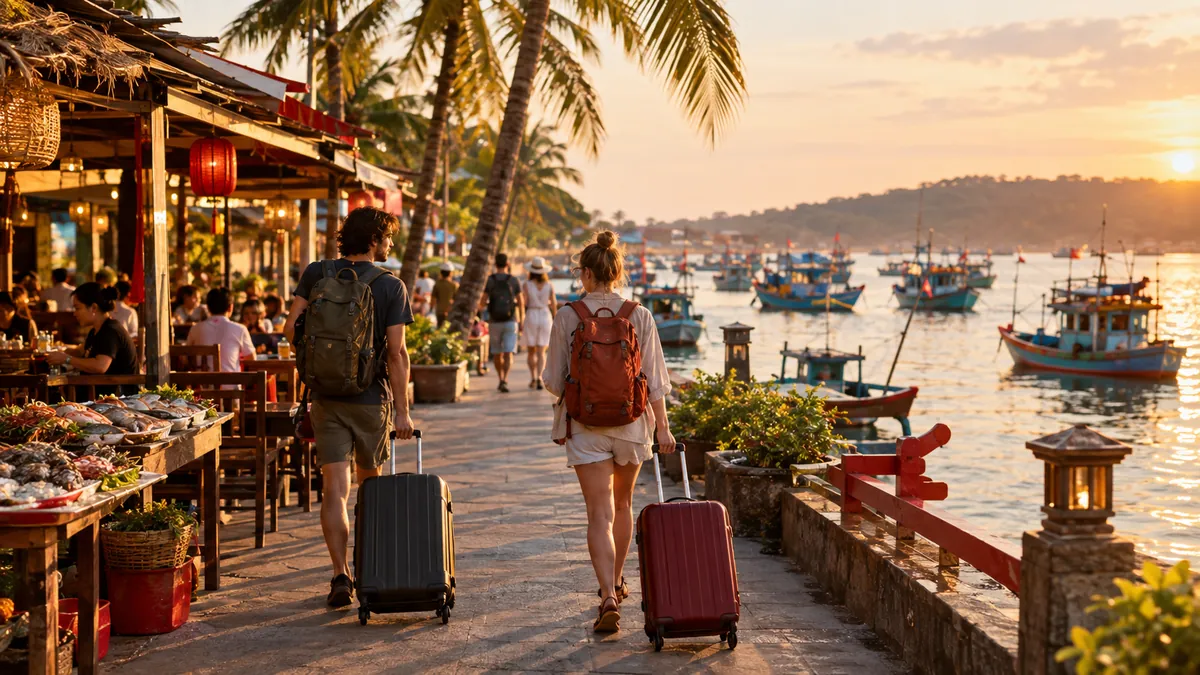
Whether you need a visa for Vietnam comes down to three things: the passport you hold, how long you want to stay, and where you cross the border. Vietnam exempts 24 nationalities for 45 days, gives citizens of nine ASEAN countries 14 to 30 days, and lets travellers of any nationality spend 30 days on Phu Quoc island visa-free. Everyone else applies for a visa, and since 15 August 2023 the online e-visa has been open to all nationalities.
Do you need a visa for Vietnam in 2026?
You need a visa unless your passport is on one of Vietnam's exemption lists, or your trip fits a special rule such as the Phu Quoc island exemption or the 5-year exemption certificate for people of Vietnamese origin.
Four situations:
- Visa exempt for 45 days. Twenty-four nationalities, mostly European plus Japan, South Korea and Russia, enter for any purpose without a visa for up to 45 days.
- Visa exempt under ASEAN arrangements. Between 14 and 30 days, depending on the country.
- Visa exempt only for Phu Quoc. Any nationality, 30 days, arriving directly at the island and staying on it.
- Visa required. This is the situation for Indian, American, Australian, Canadian and New Zealand passport holders, among many others. The standard tool is the e-visa, valid for up to 90 days, single or multiple entry, with a government fee of US$25 or US$50.
The e-visa is issued to foreigners who are currently abroad and want to enter Vietnam. It is not designed for someone already temporarily residing in Vietnam, which matters if you were thinking of extending a visa-free stay from inside the country.
Which passports get 45 days without a visa?
Twenty-four nationalities can enter Vietnam for any purpose and stay up to 45 days without a visa, under two Vietnamese government resolutions adopted in 2025.
| Nationalities | Legal basis | In force until |
|---|---|---|
| United Kingdom, France, Germany, Italy, Spain, Denmark, Sweden, Norway, Finland, Japan, South Korea, Russia | Resolution 44/NQ-CP | 14 March 2028 |
| Belgium, Bulgaria, Croatia, Czech Republic, Hungary, Luxembourg, Netherlands, Poland, Romania, Slovakia, Slovenia, Switzerland | Resolution 229/NQ-CP | 14 August 2028 |
Two details matter in practice. First, there is no minimum gap between two exempt stays, so a traveller on this list can leave Vietnam for a few days in Cambodia or Laos and come back on a fresh 45-day exemption. Second, the exemption covers any purpose, not only tourism, but it is capped at 45 days: if your plan is a 60-day or 90-day stay, an e-visa of up to 90 days is the cleaner route than arriving visa-free and hoping to sort it out later.
Both resolutions have an end date. If you are reading this close to March 2028 or August 2028, check the current list on your own government's travel advice page for Vietnam and on the official portal before you book.
Do ASEAN rules and Phu Quoc change the answer?
Yes. ASEAN passports have their own allowances, Phu Quoc has a rule that applies to every nationality, and people of Vietnamese origin have their own certificate.
| Who you are | What you get | Condition |
|---|---|---|
| Cambodia, Laos, Malaysia, Myanmar, Singapore, Thailand | 30 days visa-free | Standard ASEAN arrangement |
| Philippines | 21 days visa-free | Standard ASEAN arrangement |
| Brunei | 14 days visa-free | Standard ASEAN arrangement |
| Indonesia | 14 days visa-free since 15 July 2026 | Tourism and family visits |
| Any nationality | 30 days visa-free on Phu Quoc | Arrive directly at the island and stay on it |
| Person of Vietnamese origin, spouse, children | 5-year visa exemption certificate | Separate certificate |
The Phu Quoc exemption deserves a careful read. It covers a direct arrival from abroad and a stay on the island for up to 30 days. It is not a visa for Vietnam as a whole: if you want to continue to Ho Chi Minh City, Da Nang or Hanoi, you need a visa or a nationality-based exemption like any other traveller. If your itinerary is Phu Quoc plus the mainland, apply for an e-visa and select your entry gate from the form's list.
The 5-year exemption certificate is worth knowing about if you are part of the Vietnamese diaspora in Australia, the United States or Canada. It also covers spouses and children.
Do Indian, American, Australian and Canadian travellers need a visa?
Yes. None of these four nationalities appears on the 45-day exemption lists or the ASEAN arrangements, so a visa is required for any trip to the Vietnamese mainland, whatever its length or purpose.
For tourism, family visits and short business trips, the e-visa is the standard answer. It is applied for online on the government portal, costs US$25 for single entry or US$50 for multiple entry, covers up to 90 days, and is processed in about 3 working days. The same rules and the same fee apply to all four nationalities: there is no separate procedure and no different price.
A few situations change the paperwork rather than the visa type:
- A 10-day beach holiday in Nha Trang or Da Nang: single-entry e-visa, one entry gate, one exit gate.
- A trip that loops through Cambodia or Laos and comes back: multiple-entry e-visa at US$50.
- Paid work in Vietnam: the e-visa form offers a working purpose, but it asks for a work permit or a certificate of exemption from the work permit requirement.
- Visiting relatives: the form has a purpose for that, and asks for the host person or organisation in Vietnam.
Nationality guides with the details for each group: Vietnam visa for Indian citizens, Vietnam visa for US citizens and Vietnam visa for Australian citizens, plus a dedicated page for Canadian citizens.
How does the Vietnam e-visa work, and what does it cost?
The portal describes the e-visa in three steps: fill in the application form, pay the fee through the e-payment gateway, then receive the result by email or on the e-visa homepage. Processing takes about 3 working days, so weekends and Vietnamese public holidays do not count.
The key figures, all from the official portal:
| Item | Rule |
|---|---|
| Validity | Up to 90 days, not exceeding 90 days from the issuance date |
| Entries | Single or multiple, chosen when you apply |
| Fee | US$25 single entry, US$50 multiple entry |
| Refund | The fee is not refunded if the application is denied |
| Processing | About 3 working days |
| Who can apply | Foreigners currently abroad, all nationalities since 15 August 2023 |
| Result | By email, or downloaded from the portal |
First, note your e-visa application number as soon as you have it: the status check uses that number together with the email address you gave and your date of birth. Second, declare everything in English, sufficiently, accurately and honestly. The portal is explicit that the application is denied if the Immigration Authority finds dishonest information, and the fee is not refunded in that case.
Our step-by-step walkthrough is here: how to apply for a Vietnam e-visa.
E-visa or visa on arrival: which should you choose?
For a trip you are planning a week or more ahead, the e-visa is the simpler instrument. The visa on arrival is not a walk-up visa: you must first obtain an approval letter through a licensed Vietnamese company, then pay a stamping fee in cash on landing, US$25 for single entry or US$50 for multiple entry.
The visa on arrival is only stamped at international airports: Hanoi Noi Bai, Ho Chi Minh City Tan Son Nhat, Da Nang, Cam Ranh, Phu Quoc, Cat Bi, Lien Khuong and Can Tho. It is not available at land borders or seaports, so an overland arrival from Cambodia, Laos or China is an e-visa situation.
| E-visa | Visa on arrival | |
|---|---|---|
| Prepared how | Online application on the government portal | Approval letter through a licensed Vietnamese company |
| Government cost | US$25 or US$50, paid online | US$25 or US$50 stamping fee, in cash on arrival |
| Extra cost | None if you apply yourself | The company's fee for the approval letter |
| Where it works | Approved airports, land gates and seaports | International airports only |
| Validity | Up to 90 days, single or multiple entry | Not stated on the portal |
There is one real advantage to the licensed-company route: see our urgent visa page for faster options. With more time in hand, the e-visa is cheaper, needs no cash and works at land and sea gates too.
Which border gates accept an e-visa?
An e-visa can only be used to enter and exit through border gates on the list approved by the Government. The application form asks for an intended border gate of entry and an intended border gate of exit, chosen from dropdowns, and the two can be different.
The approved list includes Vietnam's international airports plus 16 land gates and 13 seaports. The land gates, as published by the portal in September 2026:
| Land border gate | Neighbouring country |
|---|---|
| Huu Nghi | China |
| Mong Cai | China |
| Lao Cai | China |
| Tay Trang | Laos |
| Na Meo | Laos |
| Nam Can | Laos |
| Cau Treo | Laos |
| Cha Lo | Laos |
| Lao Bao | Laos |
| La Lay | Laos |
| Bo Y | Laos |
| Moc Bai | Cambodia |
| Xa Mat | Cambodia |
| Tinh Bien | Cambodia |
| Vinh Xuong | Cambodia |
| Ha Tien | Cambodia |
The seaports on the list are Hai Phong, Hon Gai, Cam Pha, Nghi Son, Vung Ang, Chan May, Da Nang, Dung Quat, Quy Nhon, Nha Trang, Vung Tau, Ho Chi Minh City and Duong Dong.
Pick the gates you will really use, and check the dropdown in the form for the exact airport names before you commit. The portal states which gates accept e-visas; it does not say what happens if you arrive at a gate other than the one you declared, so if your route changes significantly after approval, re-read the current rules on the portal rather than guessing. A trip that leaves Vietnam and comes back, for example a side trip to Cambodia, needs a multiple-entry e-visa at US$50.
What does the application ask for, and where does accuracy matter?
The form asks for your identity exactly as printed in your passport, your trip details and a long list of background questions. The portal checks your uploads automatically and warns you when a file is unusable, so the photo, the passport scan and the spelling of your names are where care pays off.
The two files you upload:
- Portrait photo: newly taken, 4x6 cm, JPG or JPEG, under 2 MB, face straight to camera, no hat, no glasses, formal clothes, white background.
- Passport: one data page, clear, with no lost corners.
The portal reads your passport automatically and then asks you to double-check what it extracted. It also runs image checks and shows warnings when something is wrong: no face detected, face not looking straight, portrait captured from another source, too many faces, no face in the passport image, no machine-readable zone detected, passport image resolution too low, portrait resolution too low, unsupported format, or a low match rate between the portrait and the passport photo. Most of those warnings say the application may be rejected, so fix the file rather than pushing through.
Formatting rules that can spoil an otherwise complete form:
- Names must be entered as they appear on the ICAO line, the machine-readable lines at the bottom of the data page. If your passport shows only a surname or only given names, enter what you have as given names.
- Phone number in the format [country code]-[phone number], 9 to 15 characters.
- Email in a valid format, 50 characters maximum, and reachable, because the result and the status check both depend on it.
The rest of the form is declarative: other nationalities, other passports used to enter Vietnam, other valid passports, emergency contact, occupation and employer, host organisation or person in Vietnam, visits in the last 12 months, relatives in Vietnam, intended expenses, who covers the trip, payment method, health insurance, and a commitment to declare your temporary residence. There is also a violations section, for any violation of Vietnamese laws or regulations, with the act, the time, the form of sanction and the authority that imposed it. Past violations on a previous entry may lead to denial, and hiding them is exactly the dishonesty the portal warns about.
Some purposes need supporting papers: investment documents for investors, a practice licence for lawyers, a work permit or certificate of exemption for workers, written consent from the school for students, and permission for religious, press, medical or teaching activities. Foreigners already residing lawfully in Vietnam may combine tourism, visiting relatives and medical treatment without asking permission.
A family note: a child under 14 travelling on a parent's passport can be added to that parent's e-visa with their own photo. A child with their own passport needs their own application and their own fee.
What should you carry on arrival, and who declares your temporary residence?
Carry the same passport you used in the application, a copy of your e-visa, and the address of your first night's accommodation. Your temporary residence is declared by the person managing where you sleep, who passes it to the commune or ward police.
Apply with the passport you will travel on. If you renew your passport after applying, the numbers no longer match. Renew first, then apply.
| Item | Why you want it in hand |
|---|---|
| The passport used in the application | The e-visa is issued against that passport number |
| Printed or downloaded e-visa | You can re-download it from the portal with your application number, email and date of birth |
| The entry gate you declared | An e-visa works only at approved gates |
| Accommodation address and host contact | Needed for the temporary residence declaration |
| Health insurance and trip budget details | The form asks about insurance, expenses and who pays |
In a private home, a rented apartment or a relative's house, the host is the one responsible, so tell them before you arrive. You also sign a commitment to declare your temporary residence inside the e-visa form itself, so it is not an optional formality.
For passport validity rules, insurance expectations and anything else specific to your nationality, read the Vietnam entry requirements page published by your own government, listed in the sources below, alongside the official portal.
Should you apply yourself or use a service?
Apply yourself if your case is simple and your documents are clean: the government fee of US$25 or US$50 is then your only cost, and the portal does the whole job in three steps.
Use a service if you want your photo, passport scan, ICAO-format names and gate choices checked before anything is filed, or if you would rather not interpret image warnings the night before a flight. The reason to care is financial as much as practical: the fee is not refunded if the application is denied, so a second attempt means paying again and waiting another three working days or so.
We check your documents and file your e-visa on the official portal within 24 working hours, for US$74 single entry or US$99 multiple entry, government fee included. You can start an application here. Urgent processing is not available through us yet, and no service, ours included, can promise that a visa will be granted.
Sources
- evisa.gov.vn, the portal's instructions and application form: the three steps, about 3 working days, validity of up to 90 days, fees of US$25 and US$50 and their non-refundable nature, photo and passport file requirements, border gate lists, form fields and the temporary residence declaration. Checked in September 2026.
- evisa.gov.vn/faq, the portal's FAQ. Checked in September 2026.
- evisa.gov.vn/e-visa/search: status check and result download using the application number, email and date of birth. Checked in September 2026.
- Vietnamese government Resolutions 44/NQ-CP and 229/NQ-CP (2025): the 45-day visa exemption lists and their end dates of 14 March 2028 and 14 August 2028. Checked in September 2026.
- Government travel advice for Vietnam, used for entry requirements and the confirmation that the e-visa is open to all nationalities: gov.uk, travel.state.gov, smartraveller.gov.au, travel.gc.ca and New Zealand SafeTravel, Vietnam: safetravel.govt.nz. Checked in September 2026.
Questions
Do I need a visa for Vietnam as an Indian citizen?
Yes. India is not on Vietnam's visa exemption lists, so Indian passport holders need a visa for the mainland, whatever the length of the trip. The standard route is the e-visa: US$25 for single entry or US$50 for multiple entry, valid up to 90 days and processed in about 3 working days. The exception is a direct arrival on Phu Quoc island, which gives 30 days visa-free if you stay on the island.
Which countries are visa-free for Vietnam for 45 days?
Twenty-four: the United Kingdom, France, Germany, Italy, Spain, Denmark, Sweden, Norway, Finland, Japan, South Korea and Russia under Resolution 44/NQ-CP until 14 March 2028, plus Belgium, Bulgaria, Croatia, the Czech Republic, Hungary, Luxembourg, the Netherlands, Poland, Romania, Slovakia, Slovenia and Switzerland under Resolution 229/NQ-CP until 14 August 2028. The exemption covers any purpose and there is no minimum gap between two exempt stays. For a stay longer than 45 days, apply for an e-visa of up to 90 days.
Can I still get a Vietnam visa on arrival in 2026?
Yes, but it is not a walk-up visa. You need an approval letter obtained in advance through a licensed Vietnamese company, and the stamping fee is paid in cash on landing: US$25 single entry or US$50 multiple entry. It only works at international airports such as Hanoi Noi Bai, Ho Chi Minh City Tan Son Nhat, Da Nang, Cam Ranh, Phu Quoc, Cat Bi, Lien Khuong and Can Tho, never at land borders or seaports.
Can I enter Vietnam overland with an e-visa?
Yes, at the land gates on the government-approved list, including Moc Bai, Xa Mat, Tinh Bien, Vinh Xuong and Ha Tien from Cambodia, Lao Bao, Cau Treo, Na Meo, Nam Can, Cha Lo, La Lay, Bo Y and Tay Trang from Laos, and Huu Nghi, Mong Cai and Lao Cai from China. You select your intended entry and exit gate in the application form, and they can be different. The visa on arrival is not available at land borders.
How long does a Vietnam e-visa take and what if it is refused?
The official portal states about 3 working days, so weekends and Vietnamese public holidays do not count. The result arrives by email or can be downloaded from the portal using your application number, email address and date of birth. If the application is denied, the fee of US$25 or US$50 is not refunded, which is why the portal insists on accurate, honest declarations in English.
Do I need a visa to visit Phu Quoc?
No, if you arrive directly at Phu Quoc from abroad and stay on the island: every nationality gets up to 30 days visa-free. As soon as you continue to the mainland, you need a visa or a nationality-based exemption. If your trip combines Phu Quoc with Ho Chi Minh City or Hanoi, apply for an e-visa and select your entry gate from the form's list.